Dondolare: A Hand-Drawn Font Family Built for Typography Cooking
There is something refreshing about a typeface that does not try to be perfect. In a design landscape crowded with polished, hyper-refined fonts, the ones that retain a human touch often stand out the most. Dondolare is exactly that kind of font family. It is simple, hand-drawn, and unapologetically squarish in appearance. Yet beneath its straightforward look lies a carefully considered tool for typography cooking — ready to be used, experimented with, and integrated into real projects. Whether you are working on branding, editorial design, or digital interfaces, Dondolare offers a distinctive voice without demanding attention. It just works.
The Visual Character of Dondolare: Squarish, Simple, and Deliberate
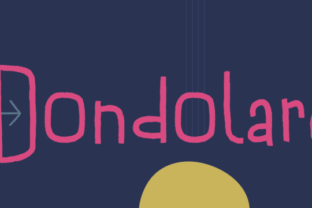
At first glance, the most defining trait of Dondolare is its geometry. The letters are squarish, which gives the typeface a sturdy, grounded feel. This is not a font that tries to mimic elegant calligraphy or fluid brushstrokes. Instead, it embraces a blocky, almost modular structure that feels both casual and intentional. The hand-drawn quality softens the edges, so the font never becomes rigid or mechanical. Each character carries subtle irregularities — a slight wobble here, an uneven stroke there — that remind you it was made by a human hand.
This combination of square proportions and hand-drawn warmth makes Dondolare versatile in ways that might not be obvious at first. It can look playful in a children's book layout, yet equally at home in a bold poster for a music festival. The squarish forms also make it highly readable at larger sizes, where the character of each letter becomes more apparent. When you use Dondolare for headlines or display text, the font does more than convey information — it sets a tone.
For designers who are tired of sanitized, overly neutral typefaces, Dondolare offers a chance to infuse personality without sacrificing legibility. It is simple enough to be approachable, yet distinctive enough to be memorable.
Two Weights, One Cohesive Voice
Dondolare comes in two weights, and that is a deliberate choice. Rather than offering a sprawling family of dozens of styles, the designer focused on what matters: a light weight and a bold weight that work together seamlessly. The light weight carries the same squarish, hand-drawn DNA but with thinner strokes, making it suitable for body text, captions, or situations where you want the texture of the font without the full visual impact. The bold weight, on the other hand, commands attention. Its thicker strokes fill the square forms more completely, creating a solid, almost chunky appearance that works beautifully for headlines, logos, and short-form emphasis.
Having two weights is not limiting — it is freeing. You do not need to spend time choosing between a dozen variations. Instead, you can focus on the hierarchy of your content. Use the light weight for longer passages where readability matters, and switch to the bold weight for headings, pull quotes, or call-to-action elements. The two weights share the same underlying structure, so they combine naturally in layouts without clashing. This consistency is one of the reasons Dondolare feels like a cohesive family rather than just a collection of unrelated styles.
Typography cooking, as the concept suggests, is about mixing ingredients with intention. With two distinct weights, Dondolare gives you just enough to create contrast, rhythm, and visual interest — without overwhelming your palette.
Extended Latin Support and Its Real-World Value
One of the most practical features of Dondolare is its support for an extended Latin character set. This might sound like a technical detail, but it has significant implications for real-world use. Many hand-drawn fonts only cover basic Latin characters, which means they fall apart when you need to typeset content in languages such as Polish, Czech, Romanian, Turkish, or Vietnamese. Dondolare handles these characters with the same hand-drawn care as the standard alphabet, so your typography remains consistent across languages.
For designers working on multilingual projects, this is a major advantage. Whether you are designing a website that serves multiple European markets, creating packaging for an international brand, or laying out a book that includes several languages, Dondolare will not force you to switch fonts mid-project. The extended Latin support also makes the font more future-proof. As your projects grow in scope, you will not hit a wall when a new language requirement appears.
From a practical standpoint, this also means that Dondolare is suitable for global branding where consistency across regions is essential. The hand-drawn character remains intact even in accented letters, ensuring that the visual identity does not break when moving from English to French to Croatian.
Where Dondolare Shines in Modern Projects
Dondolare is not a one-trick pony. Its combination of hand-drawn warmth, square construction, and two usable weights makes it a strong candidate for several contemporary use cases.
- Branding and logo design: The squarish, approachable look works well for brands that want to feel friendly, local, or artisanal. Coffee shops, bakeries, creative studios, and small retailers often benefit from a font that looks crafted rather than corporate. Dondolare gives these brands personality without being loud.
- Posters and editorial layouts: When used at display sizes, the hand-drawn texture becomes a visual asset. Posters for events, album covers, or magazine spreads can use the bold weight to anchor the design, while the light weight handles secondary information.
- Digital interfaces and web design: The squarish forms are surprisingly legible on screens, especially at larger sizes. For hero sections, navigation headers, or feature callouts, Dondolare adds a human touch to what might otherwise be a sterile digital environment. The extended Latin support is also a bonus for international websites.
- Packaging and product labels: The hand-drawn quality suggests craftsmanship, which is valuable for food, beverage, and lifestyle products. Dondolare can be used on packaging to convey authenticity and care, especially when paired with simple illustrations or natural textures.
- Social media and content marketing: In a crowded feed, distinctive typography helps content stand out. Dondolare works well for quote cards, title slides, and short-form content where the font itself adds to the message.
In each of these scenarios, the font does not just decorate — it participates. It carries the tone of the project and helps communicate something about the brand or message before a single word is read.
Practical Benefits for Designers and Developers
Beyond its visual appeal, Dondolare offers several practical advantages that make it easy to work with. The two-weight structure simplifies decision-making. You are not faced with an overwhelming family of options, which can actually slow down the design process. Instead, you have a clear choice: light for body or subtle text, bold for emphasis or headlines. This clarity is especially valuable when working under tight deadlines or collaborating with teams who need consistent guidance.
The hand-drawn nature of Dondolare also means that it pairs well with other typefaces. If you need a more neutral font for long-form reading, you can combine Dondolare with a clean sans-serif or a classic serif. The organic quality of Dondolare will provide contrast, drawing attention to headings or highlighted sections without clashing. For example, pairing Dondolare Bold with a straightforward sans-serif like Open Sans or Lato creates a dynamic hierarchy that feels modern and intentional.
For developers integrating the font into web projects, the extended Latin support eliminates the need for fallback fonts or additional language-specific files. This reduces technical complexity and ensures that the typography behaves predictably across different content management systems and localization setups. The font is also likely to perform well in terms of file size and loading speed, as the two-weight family is compact compared to larger font families.
What to Consider Before Using Dondolare
Like any typeface, Dondolare works best when you understand its strengths and limitations. The squarish hand-drawn style is distinctive, which means it will not be appropriate for every project. If you are designing a formal annual report for a financial institution or a highly technical manual, a more neutral font might serve the content better. Dondolare carries personality, and personality is not always the right fit.
Another factor to consider is legibility at very small sizes. While the light weight is readable for body text, the hand-drawn irregularities may become distracting if the text is too small. For extended reading passages, it is wise to test the font at the intended size and line spacing. In many cases, using the light weight for short paragraphs or captions, rather than full articles, will yield the best results.
Also, since Dondolare only has two weights, you will need to rely on other typographic tools — such as size, color, spacing, or pairing with another font — to create hierarchy in more complex layouts. This is not a limitation if you plan for it, but it is something to be aware of when starting a project that requires multiple levels of emphasis.
Finally, consider the context of your audience. Dondolare's hand-drawn, approachable look resonates well with audiences that value creativity, authenticity, and craftsmanship. If your target audience expects a more polished or professional appearance, you may need to balance Dondolare with other design elements to achieve the right tone.
Ready for Typography Cooking
The phrase "typography cooking" captures something essential about working with Dondolare. It is a font that invites experimentation. You can mix it with textures, layer it over images, pair it with other typefaces, and adjust its weight to create contrast. The two weights give you a base set of ingredients, but the real flavor comes from how you use them.
For designers who enjoy exploring the craft of type, Dondolare provides a flexible canvas. Its squarish structure allows for playful layouts without sacrificing readability. Its hand-drawn warmth brings a human element to digital and print projects alike. And its extended Latin support means you are not limited by language.
Whether you are building a brand identity from scratch, refreshing an existing design system, or creating a one-off poster for an event, Dondolare is worth considering. It does not try to be everything to everyone. Instead, it does one thing well: it gives your typography a voice that is simple, warm, and unmistakably hand-drawn.