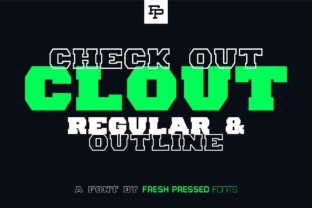
Clout Slab Serif: Bold Type with Dual Impact
There is something quietly satisfying about a slab serif that means business without shouting. Clout, the latest release from Fresh Pressed Fonts, delivers exactly that kind of presence. Designed with a sports influence in mind yet entirely comfortable outside that arena, this uppercase face offers two distinct styles—Regular and Outline—across 200 glyphs with international language support. It is a display font built for visibility, but its real strength lies in how flexibly it adapts to different hands and contexts.
What Makes Clout Worth a Closer Look
On first glance, Clout feels familiar in the best way. The slab serif tradition is rooted in sturdy, confident letterforms made for headlines and signage. What sets this typeface apart is the duality baked into its design. The Regular weight carries a solid, grounded authority that works well when you need type to anchor a composition. The Outline version, by contrast, introduces lightness and structure simultaneously—it can sit on top of imagery, layer over a filled counterpart, or stand alone as a refined alternative.
Both styles share the same bone structure, which means combining them feels intentional rather than accidental. That coherence is rare in display families that offer outline variants, and it opens up practical possibilities for anyone who works with type daily.
Another detail worth noting is the character set. With 200 glyphs and international support, Clout handles multilingual projects without breaking stride. For designers working across languages or publishing content aimed at global audiences, this removes a common friction point.
Where Clout Finds Its Footing
The sports influence that informed Clout is evident in its proportions and attitude, but calling it a sports font undersells its range. Think instead of contexts where you need a strong, upright voice—where the message has to land quickly and stay readable at a distance or at small sizes.
Branding and Identity Work
For small business owners and entrepreneurs building a visual identity from scratch, Clout offers a shortcut to presence. The uppercase-only format forces a certain kind of clarity. There is no room for lowercase fussiness, which makes logotypes, wordmarks, and taglines read with consistent impact. Pair the Regular weight with a clean sans-serif body font, and you have a workable brand system that feels both current and durable.
A local fitness studio, for instance, could use Clout Regular for its name across signage, apparel, and social graphics, then drop into the Outline version for secondary messaging or accent treatments. The visual connection between the two styles maintains brand recognition while giving you room to signal different tones—solid for primary statements, lighter for supporting ones.
Editorial and Publishing
Magazine covers, feature spreads, and digital publications benefit from display faces that command attention without overwhelming the page. Clout sits comfortably in this space. Its slab serif roots lend a slightly traditional, authoritative feel, while the geometric undercurrent keeps it from feeling dated.
Publishers and editors working on lifestyle, culture, or even B2B content can use Clout for section heads, pull quotes, or full-cover headlines. The Outline style works particularly well over photographic backgrounds where a solid block of color might obscure the image. By using the outline at a larger size and the regular weight for subheads, you create a layered hierarchy that guides the reader naturally.
Merchandise and Apparel
Anyone who has designed for print-on-demand or retail apparel knows that typeface choice can make or break a product. Clout translates cleanly onto fabric and physical goods because its forms are bold and its spacing predictable. The uppercase-only design means fewer readability surprises at different sizes, and the outline version opens up two-color and foil-stamping possibilities that flat solid type cannot offer.
A hobbyist selling branded hoodies or a marketer producing event swag can rely on Clout to hold its shape across production methods. The international glyph support also matters here—if your merchandise reaches audiences outside English-speaking markets, you will not need to switch typefaces mid-project.
Adapting Clout for Different Audiences and Goals
One typeface can serve many users, but only if its strengths are applied thoughtfully. Here is how different creators and professionals might approach Clout based on their specific needs.
For Freelance Designers
If you work with multiple clients across different industries, Clout can become a reliable utility player in your font library. Use it when a brief calls for "strong" or "authoritative" but not "aggressive." The outline version is especially useful for designing event posters, social templates, and website hero sections where you want text to feel integrated with the background rather than pasted on top.
Consider using Clout Regular for client presentations and mockups. Its clarity reads well on screen, and clients often respond positively to type that feels decisive. When presenting logo concepts or headline treatments, lead with Clout and let the client see how the two styles can work together—it often sparks conversation about versatility, which works in your favor.
For Marketers and Content Creators
Marketers need type that performs across formats: email headers, social posts, landing pages, and printed flyers. Clout handles these with minimal adjustment. The Regular weight works well for short, punchy headlines in email campaigns or Instagram carousels. The Outline version adds a layer of polish to YouTube thumbnails, webinar slides, or promotional graphics where you want the text to feel integrated with the visual.
A practical approach is to establish a simple system: use Clout Regular for primary headlines and the Outline style for secondary emphasis or decorative accents. This keeps your visual language consistent while giving you flexibility for different platforms. Because the typeface is uppercase-only, you will naturally keep headlines short, which improves readability on mobile screens and in busy feeds.
For Educators and Hobbyists
For those teaching design basics or exploring typography personally, Clout is a useful case study in contrast. The difference between Regular and Outline is obvious enough to demonstrate how weight and negative space affect readability and mood. Hobbyists working on personal projects—posters, zines, social art, or even simple websites—can experiment with layering the two styles without needing advanced skills.
A good starting exercise: take a single word, set it in Clout Regular, duplicate the layer, and apply the Outline version in a contrasting color slightly offset behind it. The result is an immediate, professional-looking depth effect that teaches spacing and color interaction in a hands-on way.
Practical Guidance for Clear and Effective Results
Working with a display typeface like Clout requires a few adjustments to keep results organized and audience-friendly.
Mind Your Tracking and Leading
Uppercase-only fonts can feel dense if letters are packed too tightly. With Clout, increasing tracking slightly improves readability, especially at larger sizes. For headlines, setting tracking to +10 or +20 points (depending on the software) gives each letter room to breathe. The Outline style benefits from a bit more spacing than the Regular, as the open strokes need clear separation to read properly.
Leading matters too. If you stack multiple lines of Clout, generous line spacing prevents the slab serifs from visually colliding. A good starting point is 1.2 to 1.4 times the point size.
Pairing with Complementary Typefaces
Clout is not a body text font, and it should not be forced into that role. Pair it with a clean, neutral sans-serif or a subtle serif for longer reading copy. The contrast between Clout's bold slab construction and a lighter, more delicate companion creates a natural hierarchy that guides the viewer without confusion.
Good candidates include geometric sans-serifs, humanist sans-serifs, or low-contrast serifs. Avoid pairing Clout with other display fonts that compete for attention—let it be the anchor and keep everything else supporting.
Color and Background Considerations
Clout Regular holds up well against busy backgrounds, but the Outline version demands more contrast. Use the outline style on solid or softly gradient backgrounds where its open interior can be clearly seen. For applications like merchandise or packaging, consider using the outline in a foil or embossed treatment to add tactile dimension.
When using both styles together, a safe rule is to let the Regular carry the most important word and the Outline handle secondary information or decorative framing. This preserves readability while still showing off the family's range.
Project Ideas to Explore
If you are looking for ways to put Clout into action, here are a few starting points that play to its strengths:
- Event poster series – Use Clout Regular for the event name and Outline for dates or location. Layer both over a strong photographic or illustrated background.
- Product packaging – A single-word product name in Clout Regular with a short description in Outline creates an elegant, modern label that works across small and large packages.
- Social media templates – Build a set of templates where the headline always uses Clout Regular and the subtitle or call-to-action uses Outline. Consistency saves time and builds recognition.
- Personal brand mark – Your name or initials set in Clout Regular with the outline version applied as a shadow or accent layer makes a simple but memorable identifier.
- Classroom or workshop materials – Titles, section headers, and key terms in Clout bring structure to handouts and slides without distracting from content.
Each of these ideas relies on the same core principle: Clout works best when its two styles are allowed to support each other. The Regular brings weight; the Outline brings air. Together, they create a visual rhythm that feels deliberate rather than accidental.
A Typeface That Rewards Attention
Clout does not try to do everything. It is an uppercase display slab serif with two clear expressions, and that focus is part of its value. For designers, marketers, small business owners, and anyone else who needs type that holds its ground without posturing, it offers a practical tool with room for creative discovery.
The sports influence gives it energy, but the execution gives it range. Whether you are building a brand from scratch, designing for print, or experimenting with layered typography for personal projects, Clout provides a foundation that is both sturdy and open to interpretation. That combination is harder to find than it sounds, and it is what makes this Fresh Pressed Fonts release worth putting to work.