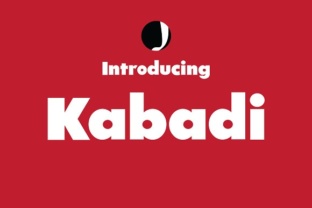
Kabadi: A Bold Display Font Built for Impact
Some fonts whisper. Others announce themselves the moment they hit the page. Kabadi belongs squarely in the second camp. Created by the Jadugar Design Studio, this strong bold display font carries a handmade energy that feels both deliberate and raw. It does not try to blend in. It demands attention, and for the right project, that is exactly what you need.
If you have spent any time browsing through premium font catalogs or scrolling past endless sans serif options that all look the same, Kabadi will stop your scroll. There is a chunky confidence to its letterforms. The strokes are thick, the shapes are slightly irregular, and the overall personality leans into a gritty, street-smart aesthetic. It is not polished to perfection, and that is precisely its superpower.
Let’s walk through what makes Kabadi tick, where it shines, and how to decide if it belongs in your next project.
What Kabadi Actually Looks Like
Visual clarity matters when you are evaluating a typeface for real work. Kabadi is a display font through and through. That means it is built for headlines, posters, logos, and any space where you need type to carry the visual load. The letterforms are heavy and condensed, with a vertical emphasis that makes words stack well in tight spaces.
The texture is where Kabadi gets interesting. The edges are not perfectly smooth. There is a slight unevenness to the strokes, as if the letters were stamped or painted onto the surface. This handmade quality gives the font a tactile warmth that you simply cannot get from a sterile geometric sans serif font or a delicate serif font. It feels human. It feels immediate.
Character shapes lean toward the unconventional. The counters are small, the x-height is tall, and the overall density means that Kabadi works best at larger sizes. Below 24 points, the details can start to crowd. But push it up to 48, 72, or larger, and the font opens up, revealing the careful balance between chaos and control that the designers built in.
The personality here is confident, a little rebellious, and unmistakably bold. This is not a font for polite communication. It is for announcements, declarations, and statements that need to leave a mark.
Where Kabadi Works Best in Real Projects
You will not want to use Kabadi for a 500-word blog article or a corporate annual report. That would be like using a sledgehammer to hang a picture. But when you need impact, this creative font delivers. Here are the applications where I have seen it perform best, and where I recommend you consider it.
- Logo design and brand identity. Kabadi carries enough personality to work as a standalone logo mark, especially for brands in music, streetwear, gaming, craft food, or creative agencies. Pair it with a clean sans serif font for body copy, and you have a brand identity that feels cohesive but not boring.
- Editorial design and packaging. Magazine covers, album art, product labels, and packaging boxes benefit from Kabadi’s dense, bold presence. It grabs attention on a shelf or a newsstand without needing bright colors or busy backgrounds.
- Posters and flyers. Event posters, concert flyers, and promotional materials are natural homes for Kabadi. The font scales beautifully, and its handmade feel adds authenticity to analog-style print work.
- Social media graphics. In a feed full of generic templates, Kabadi stops the thumb. Use it for quote cards, announcement graphics, or short-form video titles. The bold weight ensures readability on mobile screens even at small sizes.
- Merchandise and apparel. T-shirt designs, hoodie prints, and sticker packs all benefit from Kabadi’s chunky letterforms. The font reads well in single-color prints and holds its shape on fabric.
In each of these contexts, Kabadi acts as a visual anchor. It is not there to support other elements. It is there to lead.
How Kabadi Affects Readability and Visual Hierarchy
Every commercial font you choose influences how your audience processes information. Kabadi is no exception. Because the letterforms are dense and the counters are small, the font works best when you keep your text short. One word, a short phrase, or a headline of five to seven words is the sweet spot. Beyond that, legibility starts to dip, especially for readers who are not trained to decode bold typography.
But within that constraint, Kabadi excels at creating visual hierarchy. Slap a headline in Kabadi at the top of a poster, and the eye goes there first. No contest. Follow it with a clean, neutral sans serif font for subheadings or body copy, and you have a clear path for the reader to follow. The contrast between Kabadi’s weight and a lighter companion typeface does the work for you.
From a modern typography perspective, this kind of bold-to-light contrast is one of the most reliable ways to guide attention. Kabadi gives you that heavy anchor without needing extra decoration or color. It is a structural tool as much as a stylistic one.
What to Look for When Choosing Kabadi for a Project
Before you click buy, take a moment to evaluate whether Kabadi fits your specific needs. Here is a practical checklist I use with my own projects.
- Project fit. Is your brand or message bold, direct, and a little rough around the edges? Kabadi works best for personalities that are not trying to please everyone. If your project is polished, corporate, or minimal, look elsewhere.
- Font pairing test. Put Kabadi next to your intended secondary font. A clean sans serif like Montserrat or Open Sans works well. A subtle serif font like Merriweather can also create an interesting tension. Avoid pairing Kabadi with another bold display font, or you lose the contrast.
- Included styles and weights. Check what you are getting. Some premium font packages include multiple weights, italics, or alternate characters. Kabadi may come with one or two core styles. Know what is included before you commit, especially if you need flexibility for headlines across different contexts.
- Readability at your target size. Test the font at the size you plan to use it. Print out a sample at full scale. Hold it at arm’s length. Does it read clearly? If you are using it at very large sizes, Kabadi will reward you. At small sizes, you might struggle.
- Commercial licensing. If you are designing for a client or selling products, confirm that the license covers commercial use. Most commercial font sales from reputable foundries include standard commercial licensing, but always read the fine print. The last thing you want is a legal headache over a logo.
Brand Perception and Audience Engagement
Typography is a shortcut to emotion. When someone sees Kabadi, they do not read it neutrally. They feel something. Depending on the context, that feeling might be bold, confident, edgy, handmade, authentic, or rebellious. Those are powerful associations to attach to a brand or a message.
For a small business owner launching a craft hot sauce line, Kabadi communicates handmade care. For a music producer dropping a new EP, it signals raw energy. For a streetwear brand, it reinforces the street-level authenticity that the audience expects. The font becomes part of the brand identity without needing to explain itself.
Audience engagement follows the same logic. When people encounter typography that feels intentional and distinctive, they pause. That pause is the difference between a scroll-by and a click-through. In a crowded media landscape, small advantages in attention compound over time. Kabadi gives you that advantage by being unapologetically itself.
Practical Recommendations for Using Kabadi
Over the past few years working with bold display fonts, I have picked up a few habits that make projects stronger. Here is what I would tell anyone considering Kabadi.
- Give it space. Kabadi is dense. Surround it with white space so the letters can breathe. Tight layouts with this font feel claustrophobic.
- Use it sparingly. One Kabadi element per composition is usually enough. Let it be the hero. Everything else should step back.
- Pair it with a neutral partner. A simple sans serif font or a light script font for supporting text keeps the hierarchy clean. Do not compete with Kabadi.
- Test it in black and white first. If the composition works in grayscale, color will only make it stronger. If it does not work in black and white, color will not save it.
- Consider the medium. Kabadi shines in print and on screen at large sizes. For small UI elements or body text, it is not the right tool. Know the medium before you commit.
Final Thoughts on Kabadi as a Design Asset
Kabadi is not a font for every job. It is not a workhorse sans serif font that can handle body copy, subheadings, and footnotes. It is a specialist. A display font with attitude, built for moments that demand attention. The Jadugar Design Studio has created something that feels both fresh and familiar, rooted in handmade aesthetics but executed with enough craft to work in professional contexts.
If you are a designer looking for a creative font that breaks away from the safe choices, or a small business owner wanting your brand to stand out without shouting too loud, Kabadi deserves a spot in your toolkit. Test it. Pair it. Push it to large sizes. See what it does to your layouts. You might find that the boldest choice is the one that feels most natural.
And if you do use it, give the letters room to work. They will reward you with the kind of presence that makes people stop, look, and remember.