Marinaio: A Hand-Crafted Narrow Serif Font with Vintage Character and Practical Versatility
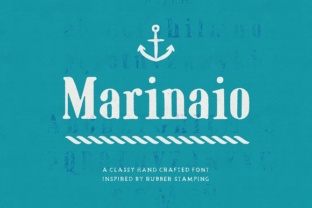
When a typeface begins its life not in a digital grid but in the physical act of carving and stamping, it carries a texture that no purely algorithm-driven font can replicate. Marinaio, created by Valerio Dell Edera under the Hederae Type Foundry, is one such font. Inspired by authentic rubber-stamping and emblem carving, this hand-crafted narrow serif brings a tactile, analog quality to modern design projects. It is not a font that tries to be everything to everyone. Instead, it offers a focused, sincere character that works best when you want communication to feel grounded, intentional, and slightly worn.
What Marinaio Is and Why It Deserves Attention
Marinaio is a narrow serif typeface with a distinctly tall, black letterform. Its most noticeable trait is the softened edges on every character, a deliberate design choice that mimics the impression left by a rubber stamp or a carved emblem pressed into paper. This is not a crisp, sterile font designed for high-resolution screens alone. It is built to evoke the warmth and imperfection of vintage printing methods. The designer, Valerio Dell Edera, drew directly from the visual language of stamping and carving, and that origin story is visible in every glyph.
What makes Marinaio worth discussing among professionals is its honesty. It does not pretend to be a neutral workhorse. It has personality, and it wears that personality openly. For anyone who works with branding, print materials, or tactile design, Marinaio offers a rare combination of structural clarity and expressive texture. It is narrow enough to fit comfortably in layouts where space is at a premium, yet its weight and soft edges give it a commanding presence on the page.
Key Characteristics and Purposeful Design
The anatomy of Marinaio is straightforward: each character is tall, black, and serifed, with edges that appear gently blunted. This is not the result of sloppy rendering but of careful design work aimed at replicating the physical process of stamping. The effect is consistent across the entire character set, which gives the font a unified, coherent voice.
The narrow proportions make Marinaio suitable for applications where you need impact without excessive horizontal space. Business cards, letterheads, and book titles can all benefit from a font that reads clearly at smaller sizes while still conveying texture. The tall x-height ensures legibility, even when the font is used in short blocks of text for invitations or branded materials.
Beyond the basic character set, Marinaio includes a substantial symbol and ornamental set. This is not an afterthought. The ornaments are designed in the same visual language as the letters, so they can be used to frame, separate, or embellish text without introducing visual dissonance. If you are designing a coffee table book or a custom stationery suite, these extras provide immediate utility.
Alternate Ligatures: A Rich Set Worth Exploring
One of the strongest features of Marinaio is its collection of alternate ligatures. The font includes the standard œ and æ, but it goes much further. Ligatures for gg, fi, tt, ff, ft, li, fh, fj, ffk, ffb, fl, and wi are all included. These are not simply auto-generated connections; they are individually crafted to maintain the stamp-like texture and narrow proportions of the font.
For anyone who works with printed materials, these ligatures solve a common problem. In narrow serif fonts, certain letter combinations can create awkward spacing or visual gaps. The ligatures in Marinaio smooth out those interactions, making the text flow more naturally. They also add an extra layer of authenticity, since many vintage printed materials used similar typographic conventions.
If you are considering Marinaio for a project, it is worth downloading the specimen file to see how these ligatures behave in context. Seeing them applied to real words will give you a much better sense of how the font performs than reading a list. The specimen file shows the range of alternates and how they can be activated depending on your software and workflow.
Real-World Performance and Practical Value
Evaluating a font like Marinaio requires looking beyond general appeal and into specific use cases. In my experience testing this typeface, it performs best in print and in digital contexts where you want a tactile, hand-rendered feel. Business cards printed on uncoated stock, for example, benefit immensely from the soft edges and narrow profile. The font does not feel cold or industrial. It feels like something made by hand, which is a meaningful distinction in a marketplace full of polished, generic typefaces.
For custom stamps, Marinaio is an excellent choice. The very design that inspired the font translates directly into stamp applications. If you are having a rubber stamp made for a small business or personal brand, using Marinaio as the source typeface will produce results that look deliberate and authentic. The softened edges help avoid the overly sharp, mechanical look that some stamps produce.
Coffee table books and invitations are other strong use cases. The ornamental set allows you to create decorative elements that match the typography, saving time on sourcing separate graphics. The narrow serif works well for titles, headers, and short passages where you want the text to carry visual weight without dominating the page layout.
On the digital side, Marinaio can be used effectively for branding assets, website headers, and social media graphics, provided the platform renders fonts with enough clarity to preserve the soft edges. Thin or low-resolution screens may lose some of the subtler texture, so it is worth testing before committing to a digital-first project. For high-resolution displays and print, the font delivers consistent results.
Who Benefits Most from Marinaio
Marinaio is not a general-purpose text font. Its narrow, black serif design makes it less suitable for long-form reading or dense body copy. If you need a font for a 50-page report or a blog with extensive paragraphs, this is not the right choice. Where Marinaio excels is in branding, packaging, short-form print materials, and any project where the typography itself is part of the visual statement.
Small business owners will find value in Marinaio for logo work, business cards, and letterhead. The font's hand-crafted quality communicates authenticity and care, which are valuable associations for independent brands. Freelancers and designers who work with boutique clients, wedding stationery, or artisanal products will find that Marinaio aligns well with those aesthetics.
Marketers creating limited-edition packaging, event invitations, or promotional materials with a vintage or handmade angle can also benefit. The ornamental set and ligatures give you tools to create cohesive, detailed layouts without layering multiple fonts that may clash. Educators and hobbyists working on personal projects like photo books or family history publications will appreciate the font's ability to add character without requiring extensive design experience.
Publishers working on niche books, especially those in the arts, crafts, or design categories, may find that Marinaio works well for chapter titles, pull quotes, and section headers. It pairs best with simpler, more neutral fonts for body text, allowing Marinaio to serve as the accent voice in the typographic hierarchy.
Quality, Consistency, and Long-Term Value
From a quality standpoint, Marinaio is well-constructed. The kerning is thoughtful, the ligatures are functional, and the ornamental set is large enough to be genuinely useful. The font holds up well across different sizes, retaining its softened texture without becoming muddy or indistinct. At smaller sizes, such as 10 or 11 points, the legibility remains solid, though the true character of the font is more apparent at display sizes between 14 and 36 points.
Consistency is strong across the character set. The tall, black serif proportions are maintained in every glyph, and the soft-edge treatment is applied uniformly. This may seem like a basic expectation, but it is not always achieved in fonts that aim for a hand-crafted look. Inconsistent edge softening or uneven weight distribution can break the illusion of a stamped impression. Marinaio avoids these pitfalls.
Regarding long-term value, this font is likely to remain useful for years if your work regularly involves vintage, handcrafted, or tactile aesthetics. Typography trends shift, but the demand for fonts that communicate authenticity and human touch is persistent. Marinaio is specific enough to be distinctive but not so eccentric that it will feel dated after a few seasons. It belongs in the toolbox of anyone who values typography as a storytelling tool rather than just a readability mechanic.
Possible Limitations to Consider
No font is perfect for every scenario, and Marinaio has limitations worth acknowledging. Its narrow, heavy serif design can feel crowded if used too liberally, especially in layouts where white space is minimal. The font performs best when given room to breathe, so avoid setting it in dense walls of text. It is also not an ideal choice for body copy in anything longer than a paragraph or two. Readers will fatigue quickly if asked to read extended passages in this style.
Digital rendering is another consideration. On lower-resolution screens, the soft edges may appear blurry or lose their intended texture. If your primary output is digital, test the font thoroughly on the devices your audience uses. For web use, consider limiting Marinaio to headers and decorative elements, using a more conventional font for body text.
Licensing is always worth verifying before committing to a font for commercial projects. Check the specific terms from Hederae Type Foundry to confirm that your intended use, whether for branding, print runs, or digital assets, is covered. Most professional foundries offer clear licensing tiers, so this should be straightforward.
Practical Recommendations for Using Marinaio
If you decide to work with Marinaio, start by exploring the ligatures and ornamental set. The specimen file is the best place to begin, as it shows practical combinations rather than isolated glyphs. Experiment with the ligatures in context to see how they affect readability and rhythm. Use the ornaments to frame titles or separate sections, but avoid overloading a single layout with too many decorative elements.
Pair Marinaio with a clean, lightweight sans-serif or a simple humanist serif for body text. This contrast will let Marinaio's character stand out without overwhelming the reader. For business cards, use Marinaio for the name and key information, and a cleaner font for contact details. For invitations, let Marinaio handle the headline and any ornamental flourishes, while using a more legible font for event details or longer text blocks.
When printing, choose uncoated or textured paper stocks to enhance the stamped effect. Coated or glossy papers can make the soft edges look less intentional. If you are producing a digital mockup or presentation, consider adding a subtle paper texture in the background to reinforce the vintage atmosphere.
Test the font at multiple sizes before finalizing your layout. Because of its narrow proportions, a size that looks perfectly balanced on screen may feel slightly different in print. Always request a proof before committing to a large print run.
Final Perspective
Marinaio is a font with a clear point of view. It does not try to be invisible or purely functional. It asks to be noticed and used in contexts where its handmade character adds meaning. For designers, small business owners, and creators who value authenticity and tactile quality in their work, Marinaio offers a reliable, well-crafted tool that delivers on its promise. It is not a font for every job, but for the jobs it suits, it is difficult to beat.