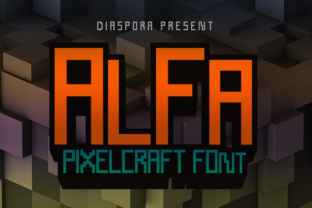
AlFa: A Pixelcraft Font That Blends Retro Charm with Modern Versatility
When you search for a typeface that feels both crafted and computational, few options deliver the same balanced character as AlFa. This unique pixelcraft font sits at the intersection of deliberate pixel art and readable typography. It does not try to mimic handwriting or imitate a classic serif; instead, it embraces its digital DNA while offering surprising warmth and clarity. For designers, game developers, and creative professionals who need a display font that stands out without screaming, AlFa provides a welcome middle ground.
What Makes AlFa a Pixelcraft Font?
The term “pixelcraft” might sound like marketing jargon, but in the case of AlFa, it describes a very specific design philosophy. Each glyph in AlFa is constructed from visible pixel units, yet the overall effect is not simply a blocky throwback to early video games. Instead, the pixel grid is used as a creative constraint, forcing each letterform to be both economical and expressive. The result is a typeface that feels rigorously structured but never cold. AlFa’s pixelcraft approach means every curve is approximated with deliberate steps, giving the font a handmade quality that is rare in purely digital typefaces.
AlFa supports basic characters, which might sound limiting until you consider how many projects rely solely on a core set of letters, numbers, and simple punctuation. For headlines, logos, short promotional texts, and user interface elements, the complete basic character set is often all you need. AlFa focuses its design energy on making those essential characters as strong as possible, rather than padding the set with obscure symbols that few people ever use. This focus pays off in readability and consistency.
Where AlFa Shines as a Display Font
Display fonts are meant to capture attention, and AlFa does so without resorting to ornamentation. Its pixelcraft structure gives it an immediate visual identity: it is clearly digital, clearly handcrafted, and clearly intentional. In headlines, AlFa creates a sense of authenticity that many modern sans-serif fonts lack. It feels less like a corporate tool and more like a personal artifact from a time when every pixel mattered.
Consider a gaming studio developing an indie title with a retro aesthetic. Using AlFa for the main menu title, splash screens, and key UI elements instantly communicates a love for pixel art without forcing the entire interface into a strict 8-bit mold. The font’s pixelcraft nature lets it sit comfortably alongside both low-resolution sprites and higher-resolution background art. It bridges stylistic gaps that other fonts cannot.
Similarly, a brand looking for a distinctive voice might choose AlFa for poster designs, social media headers, or limited-edition packaging. The pixelcraft texture adds a tactile quality to digital renders, making them feel as if they were printed with a dot-matrix or silk-screened in a small workshop. This tactile impression is powerful in an era when consumers crave authenticity.
Practical Benefits of Using AlFa in Modern Workflows
Beyond aesthetics, AlFa offers concrete advantages for designers working under real-world constraints. Because its pixelcraft construction is inherently grid-based, the font aligns perfectly with pixel grids and responsive scaling. If you are designing for screens where sharp edges and exact alignment matter—such as app icons, game HUDs, or dashboard labels—AlFa reduces the risk of anti-aliasing artifacts or fuzzy edges. It renders crisply at display sizes, especially in the range of 24px to 72px, where its pixel structure becomes a deliberate feature rather than a flaw.
File size and performance are also improved. A pixelcraft font like AlFa can have fewer nodes and curves compared to a highly detailed vector font, meaning smaller file sizes for web use and faster rendering in game engines. For a web developer loading multiple custom fonts, this efficiency translates to better Core Web Vitals scores and a snappier user experience. AlFa is well-suited for hero section headlines where performance and personality both matter.
Another practical benefit is versatility across media. AlFa works both on screen and in print. When printed at moderate sizes, its pixelcraft edges create a distinctive stippled or dot-matrix effect that stands out against smooth offset printing. This makes it ideal for flyers, zines, and posters where a low-fi, DIY aesthetic is desired. Many designers appreciate that they can use one font across digital prototypes and physical collateral without losing visual coherence.
Key Qualities to Consider Before Choosing AlFa
Before adopting AlFa into your toolkit, it helps to understand a few of its characteristics that might influence your projects.
- Readability at small sizes: While AlFa excels as a display font, its pixelcraft nature means subtle details can blur below 18px. For body text or dense paragraphs, consider pairing AlFa with a simple sans-serif companion like Inter or Open Sans. This combination preserves the retro headline punch while ensuring reading comfort.
- Character set focus: AlFa’s basic character support covers A–Z, a–z, 0–9, and common punctuation. If your project requires extensive diacritics, ligatures, or special symbols, you may need to supplement AlFa with another font or check its specific language coverage. Always review the character map before committing.
- Grid alignment: Because AlFa is pixelcraft, it assumes a certain baseline grid. If you are working on a non-standard canvas or scaling algorithm, test the font at your target resolution. The pixel steps are designed for whole-pixel increments, so scaling to fractional values can create unintended moiré patterns.
- Tone and audience: AlFa carries a distinct visual personality that is best suited for audiences who appreciate retro, craft, or tech-forward aesthetics. For conservative industries like law or finance, this font might feel out of place. However, for gaming, creative agencies, music festivals, and youth-oriented brands, AlFa resonates deeply.
Examples and Scenarios Where AlFa Excels
Imagine an e-commerce site selling handmade electronic gadgets. The product categories—like “synth kits” and “modular components”—work wonderfully set in AlFa. The font’s pixelcraft edge hints at the technical, circuit-board nature of the products while the handcrafted feel mirrors the artisanal aspect. The site’s tagline, “Build your sound,” rendered in AlFa, reinforces the idea of construction and creativity.
Think about a mobile game tutorial screen. AlFa can be used for short instructional text such as “Swipe to jump” or “Collect three gems.” Because the font’s characters are wide and open, even on small mobile screens, the words remain legible. The pixelcraft texture also reduces visual clutter, making the instructions feel like part of the game world rather than overlays.
A music festival poster promoting a retro-electronica lineup. Using AlFa for the headliner names and date gives the poster an immediate identity. Pair it with a rough paper texture and some geometric borders, and the design feels cohesive. The font’s inherent limitations—the lack of elaborate serifs or swashes—actually become strengths, as they force the designer to rely on layout and color instead of typographic frills.
How AlFa Fits into Broader Typography Trends
The rise of pixelcraft and bitmap-inspired fonts is not a coincidence. As digital interfaces become increasingly homogenous with their sleek sans-serifs, there is a growing appetite for typefaces that show their construction. AlFa satisfies this trend by wearing its pixel foundations proudly. It belongs to a family of fonts that includes Visitor, Silkscreen, and PixelOperator, but AlFa distinguishes itself through a more deliberate, hand-polished feel. Where some pixel fonts feel purely mechanical, AlFa retains a human touch in the spacing and proportions.
Modern design tools like Figma, Sketch, and Adobe XD handle pixelcraft fonts well, especially when you enable “anti-aliasing” at the right level. For game engines such as Unity or Godot, AlFa can be imported directly as a sprite font, and its grid-based structure simplifies texture atlas generation. This technical compatibility reinforces its value in production pipelines.
Practical Recommendations for Getting the Most Out of AlFa
- Test at multiple sizes. Open your design software and try AlFa at 36px, 48px, and 72px. Observe how the pixelcraft steps look at each size. For headline use, choose a size where individual pixels are clearly visible but not distractingly large.
- Pair with a neutral body font. AlFa works beautifully with simple sans-serifs like Montserrat, Roboto, or even a clean monospace like JetBrains Mono. The contrast between a pixelcraft head and a smooth body creates visual hierarchy without conflict.
- Use color to amplify the pixel effect. Because of its pixelcraft structure, AlFa lends itself to two-color or gradient effects. A solid pixel block can hold a subtle gradient or a hard outline, adding depth without losing clarity.
- Consider letter spacing. AlFa’s default spacing is tight, which works well for compact headlines. For more airy or modern layouts, adding a few points of tracking can make the font feel less dense and more sophisticated.
- Download and experiment with the actual character set. Always check the font’s raw glyphs to see how it handles numbers, punctuation, and kerning pairs. With AlFa’s basic coverage, ensure that your specific text content does not fall outside that set.
A Few Observations on the Future of Pixelcraft Fonts
Type design is moving in cycles, and the current fascination with craft, artifact, and digital heritage shows no signs of fading. AlFa occupies a sweet spot: it is evocative without being nostalgic, technical without being cold. As more brands seek to differentiate themselves in crowded digital spaces, fonts that carry a story—like AlFa’s pixelcraft origin—become strategic assets. A font that feels built, not just drawn, conveys care and intentionality. In a world of AI-generated designs, that human touch matters.
Whether you are designing a game, a startup landing page, a poster series, or a mobile app, AlFa offers a reliable yet distinctive voice. It asks for very little in terms of technical overhead but gives back a great deal in personality. For those who appreciate the craft of every pixel, AlFa is more than a font—it is a statement.
As you consider your next project, take time to experiment with AlFa in your layout. Sometimes the best decisions come from trying something that feels a little different. With its pixelcraft foundation and basic character support, AlFa proves that constraints can spark creativity rather than limit it.