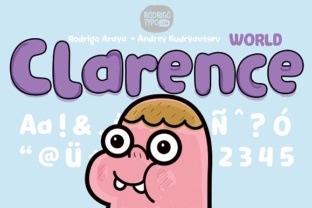
Clarence World – A Font Inspired by the Cartoon Network Series
When evaluating display fonts for a project with a playful, animated, or youthful tone, the options range from polished geometric sans-serifs to intentionally rough hand-drawn lettering. Among these, Clarence World occupies a distinct niche. Designed by Rodrigo Typo, this typeface draws direct inspiration from the logo of the Cartoon Network series Clarence. For designers, content creators, and branding specialists researching fonts that evoke nostalgia, informality, or cartoon-like energy, understanding what Clarence World offers—and where it falls short—can help determine whether it is the right choice for a specific use case.
This article provides an objective evaluation of Clarence World, covering its design characteristics, practical strengths and limitations, ideal use scenarios, and situations where alternative fonts might serve you better. The goal is to help you make an informed decision based on your project’s goals, audience, and technical requirements.
What Is Clarence World?
Clarence World is a display typeface created by Rodrigo Typo, a designer known for producing fonts with handcrafted, expressive, and often unconventional aesthetics. As the name suggests, the font is directly inspired by the lettering style used in the logo of the Cartoon Network animated series Clarence. That logo features irregular, bouncy, slightly distorted letterforms that mirror the show’s quirky and childlike sensibility.
The font captures those same visual cues: uneven stroke widths, playful proportions, and a deliberately imperfect finish. It is not a clean, uniform typeface. Instead, it embraces irregularity as a key part of its character. Clarence World is best classified as a cartoon or hand-drawn display font, meaning it is designed for headline use, short text, and expressive applications rather than extended body copy.
Why Consider Clarence World?
Understanding the reasons someone might be drawn to Clarence World helps clarify its value proposition. Several common motivations emerge among designers and content creators evaluating this font:
- Nostalgic appeal: For audiences familiar with the Clarence series, the font instantly evokes the show’s tone. This can be an effective emotional shortcut in branding or content aimed at younger adults who grew up with the show.
- Distinctive personality: Many projects require a typeface that feels human, imperfect, and approachable. Clarence World delivers this without appearing overly polished or corporate.
- Visual energy: The irregular letter shapes create a sense of movement and spontaneity. This works well for posters, social media graphics, merchandise, and other contexts where standing out is important.
- Niche authority: Because it stems from a specific cultural reference, the font can signal an insider understanding of cartoon aesthetics, which may resonate with certain audiences.
These reasons are valid, but they also point to the font’s specialized nature. The very qualities that make it appealing in one context can become drawbacks in another.
Benefits and Tradeoffs
Like any specialized typeface, Clarence World involves a set of benefits and tradeoffs that you should weigh against your specific requirements.
Strengths
- Strong personality: The font immediately communicates a casual, playful, and informal tone. If your project needs to feel friendly, irreverent, or childish in a positive sense, Clarence World can achieve that with a single line of text.
- Cultural resonance: For audiences who recognize the Clarence reference, the font carries additional meaning. This can be especially useful in fan communities, retro-themed content, or projects that intentionally reference 2010s Cartoon Network programming.
- Unique design: Because it is not a generic cartoon font, Clarence World helps avoid the “clip art” effect that can come with overly common display faces. It has a specific identity.
- Legibility at larger sizes: The bold, irregular shapes hold up well when used for headlines, titles, and short messages. The distinctive outlines make words recognizable even when separated from context.
Limitations
- Limited readability for extended text: The uneven stroke widths and unconventional letterforms make the font difficult to read in paragraphs or small sizes. It is unsuitable for body copy, captions, or any application where reading comfort matters.
- Narrow emotional range: The font’s personality is strongly fixed. You cannot easily adapt it to a more serious, professional, or elegant context without creating a mismatch between tone and content.
- Licensing considerations: Depending on where you obtain the font, licensing terms may restrict commercial use, web embedding, or modification. Always verify the license from Rodrigo Typo or the distributor before committing to a project.
- Character set and language support: Some display fonts offer limited character sets. If your project requires extensive diacritics, special characters, or multilingual support, you should check whether Clarence World meets those needs.
These tradeoffs do not make the font “bad.” Instead, they define the situations in which it performs well and those where it does not.
When Clarence World Is a Strong Fit
If your project aligns with the following conditions, Clarence World may be an excellent choice:
- Children’s media and products: Books, apps, toys, and educational materials aimed at younger audiences often benefit from fonts that feel handmade and energetic. The font’s cartoon origin fits naturally here.
- Informal branding: Brands that want to appear approachable, quirky, or anti-corporate can use the font to signal a casual identity. Food trucks, boutique shops, creative agencies, and entertainment brands are common examples.
- Posters and event graphics: For concerts, festivals, children’s parties, or community events, the font’s visual punch makes it effective for grabbing attention at a distance.
- Social media content: Short, image-based posts on platforms like Instagram, TikTok, or YouTube thumbnails can benefit from the font’s immediate recognizability and emotional tone.
- Fan projects and nostalgia-driven content: If your audience explicitly values references to early 2010s Cartoon Network content, the font becomes a meaningful design choice rather than a random aesthetic preference.
In these cases, the font’s limitations become secondary to its ability to communicate a specific mood quickly and memorably.
When to Consider Alternatives
No typeface works for every project. There are several scenarios where you may want to look beyond Clarence World:
- Professional or corporate communication: If the project demands a neutral, authoritative, or trustworthy tone—such as financial documents, legal notices, or corporate reports—the font’s informal character will undermine your message.
- Body text or long-form reading: For articles, books, manuals, or any content where readers need to read more than a few words at a time, a readable text face is essential. Clarence World is not designed for this purpose.
- Minimalist or modern aesthetics: If your design direction leans toward clean lines, geometric precision, or understated elegance, the font’s irregularity will clash. A simple sans-serif or refined serif would serve the project better.
- Broad demographic targeting: For mass-market products or services intended for a wide age range, the font’s specific cultural reference may not resonate equally with all groups. Some viewers may find it too childish or niche.
- Where licensing is restrictive: If your use case requires embedding in an app, using on a commercial website, or modifying the letterforms, you need to confirm that the license permits those activities. Some free or low-cost display fonts may not offer the flexibility you need.
When these conditions apply, alternative display fonts with a similar spirit but broader applicability may be more suitable. Fonts like Komika Axis, Shlop, or hand-drawn families such as Circus or Rough Draft offer cartoon-like energy while providing different design nuances, better language support, or more flexible licensing.
Practical Decision-Making Insights
To determine whether Clarence World aligns with your goals, consider the following practical steps:
- Test in context: Download the font and apply it to a mock-up of your actual project—whether that is a poster, a logo draft, or a social media graphic. Evaluate how it reads at the intended size and against your other design elements.
- Check the license: Before committing, read the end-user license agreement carefully. Confirm whether it covers your distribution method (print, web, app, broadcast) and whether any restrictions affect your workflow.
- Evaluate your audience: If your audience is likely to recognize and appreciate the Clarence reference, the font can be a powerful asset. If not, ask whether the font’s general aesthetic still serves your message without relying on that cultural connection.
- Pair it wisely: Since Clarence World carries strong visual weight, it pairs best with simple, neutral fonts for secondary text. A clean sans-serif like Open Sans or Lato typically provides contrast without competing.
- Consider alternatives first: List two or three alternative display fonts that offer a similar playful feel. Compare them side by side. Often, the best choice becomes clear when you see how each font handles your specific content.
Remember that selecting a display font is rarely a permanent commitment. For one-off projects, a niche choice like Clarence World can be exactly what you need. For long-term branding or scalable content systems, you may value versatility more than specificity.
Final Thoughts on Evaluating Clarence World
Clarence World is a well-executed display typeface that delivers exactly what its name and inspiration promise: a cartoon-like, hand-drawn aesthetic rooted in a specific cultural reference. Its usefulness depends on how closely your project matches that intended tone. For informal, playful, nostalgia-driven, or youth-oriented work, it can be a strong and distinctive choice. For contexts requiring readability, professional restraint, or broad appeal, alternatives will likely serve you better.
By focusing on your project’s audience, message, and practical constraints, you can decide whether Clarence World brings genuine value or whether its niche personality introduces more friction than benefit. As with any specialized tool, the key is not to ask whether the font is “good” in an abstract sense, but whether it is good for this specific purpose.