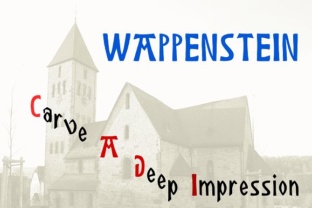
Wappenstein: Heraldic Inspiration for Modern Design
In 1562, a master carver known only as the “Meister des Brenkener Familienepitaphs” cut into stone what would become a lasting visual record of the Brenkener family’s identity. That carved memorial, now housed in the Erzbischöfliches Diözesanmuseum in Paderborn, Germany, is more than a historical artifact. It is the direct inspiration for Wappenstein, a typeface that translates the precision, weight, and symbolic language of heraldic stone carving into a digital form. A Wappenstein, in its original meaning, is a stone bearing a carved heraldic achievement—a coat of arms, a crest, a family emblem. The font captures that same sense of permanence, structure, and deliberate craftsmanship.
For designers, creators, and communicators working across both digital and physical spaces, Wappenstein offers something rare: a typographic voice that feels carved rather than written. It carries the gravity of inscription work without sacrificing readability. This article explores what makes Wappenstein compelling, how different professionals can put it to use, and practical ways to keep your work clear, effective, and visually grounded.
What Makes Wappenstein Interesting
Most typefaces are derived from handwriting, printing, or calligraphy. Wappenstein draws from a different lineage: monumental stone carving. The original epitaph in the Brenkener Pfarr Kirche was not meant to be read quickly. It was meant to endure. Every stroke had to be cut with intention because the material—stone—offered no margin for error. That constraint is precisely what gives Wappenstein its distinctive character.
The letterforms show clear chisel influence. Serifs are sturdy and geometric. Terminal ends feel truncated, as if the carver stopped exactly at the line. There is a horizontal tension in the design that echoes the careful layout of heraldic inscriptions. Yet the font is not merely a revival of an old style. It has been adapted for modern typesetting, with consistent spacing, multiple weights, and support for extended character sets.
What makes Wappenstein truly useful is its ability to communicate authority and tradition without feeling dusty or inaccessible. It works because it is specific. It does not try to be all things to all people. It knows what it is: a typeface rooted in the visual language of heraldry, stone, and family legacy.
Creative Directions for Wappenstein
The heraldic origins of Wappenstein naturally point toward certain applications, but the most interesting uses often come from pushing against expectations. Let’s look at several creative directions, each suited to different goals and audiences.
Branding with Gravitas
For brands that want to signal heritage, trust, or permanence, Wappenstein can serve as a display face for logos, wordmarks, or taglines. A law firm, a heritage distillery, a family-run manufacturing company, or a cultural institution could all benefit from the unspoken message that Wappenstein carries: “We have been here, and we will remain.” The trick is to pair it with a simpler, more neutral secondary typeface so the overall system does not become overwhelming. A clean sans-serif for body copy lets Wappenstein perform its role as the anchor without competing for attention.
Packaging and Product Labels
Wappenstein is well suited to packaging that needs to convey craftsmanship or origin. Think of wine labels, premium chocolate boxes, craft beer cans, or small-batch spirits. The carved quality of the lettering suggests artisanal methods and attention to detail. You can use it for the product name or the most important descriptive line, then support it with a lighter type for ingredients or tasting notes. The contrast between heavy, stone-like lettering and a delicate secondary face creates a pleasing visual tension that buyers often associate with quality.
Editorial and Publication Design
Magazines, annual reports, and specialty publications can use Wappenstein for chapter headings, pull quotes, or section dividers. Because it evokes stone and inscription, it works well for content that deals with history, archaeology, genealogy, architecture, or fine art. But do not limit it to those topics. A travel publication could use Wappenstein for destination headlines in regions known for medieval or Renaissance heritage. A literary journal might use it for the title of a story that deals with legacy, memory, or identity. The key is to use it sparingly so each appearance feels deliberate.
Event Branding and Invitations
For formal events—galas, award ceremonies, academic conferences, or cultural festivals—Wappenstein lends an air of ceremony. Wedding invitations, particularly those with a traditional or Gothic theme, can use the font for the couple’s names or the main event title. Because the typeface carries historical weight, it can also be effective for museum exhibition announcements, gallery openings, or heritage tours. The audience for these events often appreciates design that references the past without being a direct replica of it.
Digital Applications with a Physical Feel
Wappenstein does not have to stay in print. On the web, it can be used for hero headings, landing page titles, or navigation elements in projects where the brand identity demands a grounded, authoritative tone. When combined with subtle textures, low-contrast backgrounds, or muted color palettes, the digital rendering can mimic the feeling of carved stone. This is effective for architectural firms, historical societies, or educational platforms focused on European history. Just be mindful of legibility on small screens—Wappenstein works best at larger sizes in digital contexts.
Adapting Wappenstein for Different Audiences
Different users will need to approach Wappenstein in different ways. Here is how specific groups can adapt it to their own goals.
For Designers and Creative Professionals
Your job is to make Wappenstein work within a system. Start by testing it in black and white only. If the composition holds without color, it will hold with it. Pair Wappenstein with a neutral sans-serif like Helvetica, Frutiger, or Open Sans for body text. Avoid pairing it with another display typeface with strong character—they will compete. Use Wappenstein in all caps for maximum impact, or in title case for a slightly softer feel. Do not use it in all-lowercase for large blocks of text; the chisel forms need space around them to breathe.
For Small Business Owners and Entrepreneurs
If you run a business with a long history—or even if you want to project one—Wappenstein can help you tell that story. Use it on your storefront sign, your website header, or your product packaging. But do not force it into places where it does not fit. If your brand is playful, fast, or trend-driven, Wappenstein may feel heavy and out of place. It is best suited for businesses where trust, tradition, and quality are the primary selling points. Think of it as the typographic equivalent of a solid oak door or a hand-stitched leather cover.
For Educators and Hobbyists
If you teach typography, history, or visual communication, Wappenstein is a valuable case study. It shows how a historical artifact can be translated into a modern tool without losing its essence. Students can analyze the letterforms and compare them to the original stone carving. Hobbyists working on genealogy projects, family crest designs, or historical reenactment materials will find Wappenstein immediately useful for creating authentic-looking documents, labels, or signage.
For Content Creators and Marketers
Use Wappenstein in thumbnails, social graphics, or video titles when your content touches on history, craftsmanship, or authority. A YouTube channel about European architecture, a podcast about family history, or a newsletter about traditional trades can all benefit from the visual cue that Wappenstein provides. Just keep it legible at small sizes—if your thumbnail or graphic is going to appear mostly on mobile, test it at actual size before committing.
Practical Guidance for Clear Results
Working with a typeface as distinctive as Wappenstein requires attention to fundamentals. Here are practical recommendations to keep your results clear, effective, and audience-friendly.
- Use Wappenstein at display sizes only. Below 18 points, the chisel details may become muddy or lose impact. Reserve it for headings, titles, and short emphasis lines.
- Limit it to one or two applications per project. If you use Wappenstein for the main heading, do not also use it for subheadings and captions. Let it be the singular voice in a hierarchy.
- Control spacing carefully. Wappenstein benefits from generous tracking (letter-spacing) in all-caps settings, which echoes the spacing of carved inscriptions. In title case, use normal tracking and rely on the letterforms themselves.
- Choose backgrounds that support the stone aesthetic. Warm grays, muted ochres, charcoal tones, and soft ivories all reinforce the carved feel. Avoid high-gloss or neon backgrounds that fight the texture.
- Test on your final medium. Print, screen, embossing, foil stamping, and laser engraving will each render Wappenstein differently. Always test at the intended size and material before going to production.
Consistency matters most. If you commit to using Wappenstein as part of a brand or project identity, use it the same way every time. That means standardizing your usage—weight, size, color, spacing, and positioning—so the audience begins to associate the visual language with your message.
Keeping Originality Without Losing Clarity
One risk with a typeface as historically specific as Wappenstein is that it can tip into cliché if used carelessly. A coat of arms, a decorative border, and Wappenstein in gold on a dark background can feel like a medieval fantasy poster rather than a serious design. To keep your work original and grounded, focus on restraint. Use Wappenstein for one strong element and let everything else support it.
Another approach is to pair Wappenstein with unexpected content. A modern startup with a minimalist brand could use Wappenstein for its primary wordmark precisely because the contrast between old and new creates interest. A tech company documenting its engineering heritage might use the font for chapter numbers in a white paper. When the context breaks the expected pattern, the typeface feels fresh rather than derivative.
Finally, remember that good typography is invisible in the best way. When Wappenstein is used well, the audience feels the weight of the message without necessarily noticing the font. That is the goal. The typeface is a tool, not the message itself.
Practical Inspiration: Project Ideas
To help you get started, here are three concrete project ideas that use Wappenstein in different contexts.
Project One: Family History Website. A genealogist wants to present her research in a way that feels respectful of the past but works well on the web. She uses Wappenstein for the site title and each major family name in the navigation. Body text is set in a clean serif like Source Serif Pro. The background uses a subtle parchment texture. The result feels archival without being slow to load.
Project Two: Craft Distillery Label. A small-batch gin producer uses Wappenstein in white letters on a dark green label for the product name. The secondary text—botanicals, alcohol content, origin—is set in a thin sans-serif. A gold foil stamp on the bottle cap echoes the heraldic feel. The label communicates tradition even though the distillery is only three years old.
Project Three: Museum Exhibition Catalog. A museum in Paderborn produces a catalog for an exhibition on 16th-century epitaphs. Wappenstein is used for the catalog title and for all section headers. Pull quotes from historical documents are set in italic versions of the font. The body text is a classic book face like Garamond. The catalog’s design feels unified and historically informed without being overwrought.
Each of these projects uses Wappenstein in a way that respects the source material—the carved stone of the original Brenkener epitaph—while serving a modern audience. That balance is the key to working with any historically inspired typeface.
Final Thoughts
Wappenstein is not a neutral typeface. It comes with history, weight, and a specific visual language rooted in heraldic stone carving. That specificity is its strength. For designers, entrepreneurs, educators, and creators who need a typographic voice that speaks of permanence and craftsmanship, Wappenstein offers something difficult to find elsewhere. Use it deliberately, pair it thoughtfully, and let the carved forms do the work.
The Meister des Brenkener Familienepitaphs cut a family’s legacy into stone nearly five centuries ago. Today, that same legacy can take form in digital type, print, packaging, and signage. The medium has changed. The intention—to mark something as important, enduring, and worth remembering—remains the same.