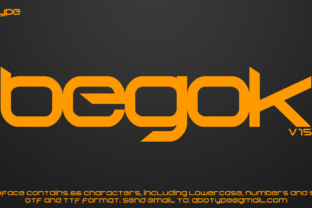
Begok and Begok v15: A Display Font Defined by Its Unconventional Cut-Off Ends
Typography is rarely just about readability. In the world of graphic design, branding, and digital media, the personality of a typeface often determines the success of a visual composition. Among the many display fonts available today, few carry as distinctive a visual signature as Begok, particularly in its Begok v15 iteration. This typeface does not try to blend in. It makes no apologies for its raw, unfinished appearance. The ends of each character are deliberately cut off, creating a look that is simultaneously brutal, modern, and strangely elegant. For designers seeking a font that speaks with a bold, unpolished voice, Begok and Begok v15 offer something genuinely unique.
What Makes Begok and Begok v15 Stand Out
At first glance, Begok appears almost incomplete. The terminals of its strokes are abrupt, as if the glyphs were sliced cleanly with a blade. This is not a flaw or a rendering issue—it is the defining feature of the typeface. In version 15, this characteristic is refined and pushed further. The cut-off ends are more pronounced, giving each letterform a stoic, architectural quality. Unlike rounded or serifed fonts that soften communication, Begok v15 communicates urgency, strength, and directness.
The font belongs to the display category, meaning it is designed for large sizes rather than body text. This is crucial to understand before using it. At 72 points or larger, the cut-off ends become a commanding visual element. At smaller sizes, the effect may be lost, or worse, the letters might appear broken. Begok v15 is not a workhorse typeface for paragraphs—it is a weapon for headlines, logos, posters, and any medium where impact is the priority.
Another key quality is the balance between geometry and organic irregularity. While the cut-off ends create a rigid, almost stencil-like feel, the underlying letter proportions retain a sense of flow. The counters—the enclosed spaces inside letters like o or e—are generous, which helps maintain legibility despite the harsh terminals. This tension between precision and rawness is what makes Begok v15 so effective in contemporary design.
Practical Applications Across Modern Workflows
Where does a font like Begok fit into real-world projects? The answer is broader than one might expect. While it naturally appeals to designers working in punk, grunge, or industrial aesthetics, its use has expanded into mainstream branding, especially in tech, fashion, and entertainment.
Branding and Logo Design
Startups and established brands alike are moving away from safe, generic typography. A logo set in Begok v15 immediately signals that the company is unconventional, bold, and willing to take risks. The cut-off ends suggest that the brand values honesty over polish. For example, a streetwear label, a skateboard company, or a craft brewery could use Begok to communicate authenticity and edge. The font works exceptionally well in monochrome palettes, where the sharp terminals create high contrast against any background.
Posters, Flyers, and Event Graphics
Print media remains a stronghold for display fonts, and Begok v15 excels here. A concert poster, a gallery opening, or a product launch flyer benefits from the typeface's ability to grab attention from a distance. The cut-off ends create a sense of movement—the eye follows the abrupt edges as if reading a stencil that was hastily applied. When paired with bold imagery or distressed textures, the font amplifies the raw energy of the design.
Digital Interfaces and Web Headers
Screen design is often dominated by clean sans-serif fonts like Inter or Roboto. But for hero sections, landing page headers, or call-to-action buttons, a display font like Begok v15 can dramatically increase engagement. The key is restraint. Using Begok for a single word or phrase on a webpage—such as “DROP” or “NOW”—creates a focal point that users cannot ignore. The cut-off ends break the monotony of smooth screen typography, adding a tactile, almost analog feel to digital experience.
Packaging and Merchandise
Product packaging is another area where Begok shines. Whether it is a limited edition sneaker box, a craft beer label, or an artisanal hot sauce bottle, the font’s unfinished look suggests a product that is handmade, raw, or exclusive. The v15 version, with its refined cut-off details, prints well on both matte and glossy surfaces. It also works beautifully in foil stamping or debossing, where the physical cut of the metal die echoes the font’s own sharp terminals.
Practical Benefits of Choosing Begok v15
Beyond its visual appeal, Begok v15 offers several practical advantages that make it a smart choice for designers who need reliable performance without sacrificing personality.
- High legibility at large sizes — Despite the cut-off ends, the letterforms remain clearly recognizable. The v15 iteration has been optimized so that even lowercase letters maintain their distinct shapes. This means your message does not get lost in the style.
- Versatile weight and style range — Begok v15 typically includes multiple weights, from thin to black, and often comes with italic variants. The cut-off effect works differently across weights: lighter versions feel airy and delicate, while heavier weights are imposing and aggressive. This range gives you flexibility within a single type family.
- Clean vector outlines — The font files are built with precision. There are no unnecessary nodes or messy curves. This ensures smooth scaling from a business card to a billboard without loss of quality. The cut-off ends are intentional paths, not artifacts, so they render perfectly in any application.
- Cross-platform support — Whether you work in Adobe Creative Cloud, Figma, Sketch, or Affinity, Begok v15 installs and behaves predictably. The OpenType features, including alternate characters and ligatures, are well-documented and easy to access.
- Memorable brand recall — A brand or campaign that uses Begok v15 is unlikely to be confused with another. The unique cut-off ends become a mnemonic device. People remember the font, and by extension, they remember the message.
What to Consider Before Using Begok
No typeface is perfect for every situation, and Begok v15 is no exception. Understanding its limitations will help you use it more effectively and avoid common pitfalls.
Size matters immensely. As mentioned earlier, Begok is a display font. Using it at body text sizes (below 18 points) will not only reduce its impact but may also confuse readers. The cut-off ends can make small letters look broken or malformed. Reserve Begok for headlines, titles, and short phrases where it can occupy at least 36 points, preferably larger.
Context and audience. The font’s aggressive, unfinished aesthetic may not suit every industry. A law firm, a financial institution, or a healthcare provider might find Begok too harsh. It communicates disruption and authenticity, not trust and stability. Always consider your brand’s voice and your audience’s expectations. If you need to convey sophistication or tradition, look elsewhere. If you want to challenge norms, Begok is an excellent choice.
Pairing with other fonts. Because Begok v15 is so distinctive, it demands careful pairing. It works best with simple, neutral typefaces that do not compete for attention. A clean sans-serif like Helvetica Now, a geometric font like Futura, or even a classic serif like Garamond can provide balance. The idea is to let Begok be the star while the supporting text remains invisible in its clarity.
Legibility in motion. If you plan to use Begok in video titles or animations, test it thoroughly. The cut-off ends can cause flickering or aliasing in some motion graphics software, especially at lower resolutions. Working with vector-based animation tools and adding a subtle anti-aliasing pass often solves this issue.
Real-World Scenarios and Recommendations
To give you a clearer sense of how Begok and Begok v15 perform, consider these typical use cases. Each scenario highlights a different strength of the typeface.
Scenario 1: A music festival branding kit. The designer needs a font that conveys loud, raw energy. They choose Begok v15 for the main title on posters, wristbands, and merchandise. The cut-off ends mimic the jagged sound waves of heavy guitar riffs. The font is paired with a thin, all-caps sans-serif for secondary information like dates and venue. The result is cohesive, memorable, and true to the festival’s identity.
Scenario 2: A tech startup’s landing page. The company builds tools for independent creators. They want to stand out against corporate competitors. The hero section uses Begok v15 for the tagline “Build Without Permission.” The sharp, cut-off terminals reinforce the rebellious message. Below, a clean system font handles the explanatory text. The page loads quickly, and the typography hierarchy guides the user naturally toward the call-to-action button.
Scenario 3: A limited edition sneaker release. The packaging uses a monochrome design with heavy black type. Begok v15 in its bold weight is applied to the word “EXCLUSIVE” on the box lid. The cut-off ends align with the angular design of the shoe itself. Customers immediately associate the font with the product’s limited availability and streetwear credibility. Social media posts featuring the box generate high engagement, partly due to the typography’s social shareability.
Observations on the Evolution from Begok to Begok v15
The original Begok was already a distinctive font, but the v15 update brings meaningful improvements. The spacing between characters has been refined to avoid collisions at larger sizes. The cut-off angles are more consistent across the entire character set, which reduces visual noise. Additionally, v15 introduces expanded language support, including Cyrillic and extended Latin, making it viable for international branding projects.
Another notable improvement is the inclusion of contextual alternates. In earlier versions, the cut-off ends could sometimes feel repetitive. With v15, certain letter combinations automatically adjust their terminal angles to create a better visual rhythm. This is particularly noticeable in words with repeating letters, such as “Bold” or “Drop.” The result is a more polished reading experience without sacrificing the raw, edgy soul of the typeface.
For designers who already own the original Begok, upgrading to v15 is straightforward. The new version maintains backward compatibility, so existing projects will not break. The additional glyphs and features simply expand your creative toolkit. If you are new to the font, starting with v15 ensures you have the most refined version of this unique display typeface.
Final Thoughts on Using Begok and Begok v15
A display font like Begok is not for every occasion, and that is precisely its strength. In a world saturated with polished, predictable typography, the cut-off ends of Begok v15 offer a refreshing alternative. They remind us that imperfection can be intentional, that rawness can communicate as powerfully as refinement. Whether you are designing a brand identity, a concert poster, or a product package, this font gives you a way to say something bold without relying on images or colors alone.
The practical benefits—clean vectors, multiple weights, cross-platform reliability, and memorable character—make it a valuable addition to any designer’s type library. Just remember to respect its limitations: use it large, pair it thoughtfully, and let it lead the composition. When used well, Begok v15 does not just display words. It displays attitude.